How to minimise sensor cooling requirements in 1550 nm IR systems
26th May 2026
Cooling 1550 nm infrared sensors can deliver substantial performance gains by suppressing temperature‑dependent noise mechanisms that limit sensitivity, range, and dynamic range in demanding optical systems. InGaAs and related III–V detectors operating near 1550 nm are particularly susceptible to dark current, associated shot noise, and excess noise originating in the readout chain, all of which increase strongly with junction temperature and degrade achievable signal‑to‑noise ratio (SNR) in use cases such as LiDAR, optical time‑of‑flight ranging, and precision optical power monitoring. In these devices, thermally generated carriers contribute a dark current that is indistinguishable from photo‑current at the circuit level; the corresponding shot noise scales with the square root of the total current, so the exponential rise of dark current with temperature directly translates into a rapid SNR penalty as operating temperature increases. This effect is most severe in low‑flux regimes, for example when a LiDAR receiver must detect return pulses corresponding to only tens or hundreds of photons within a short integration window, or when a power‑monitoring photodiode must resolve small fractional changes in optical power over a wide dynamic range. In such conditions, dark‑current‑induced shot noise and temperature‑dependent excess noise in the front‑end electronics can easily dominate other noise sources and set the system‑level detection threshold.
Thermoelectric coolers (TECs) provide a practical means for system designers to treat detector temperature as an explicit design variable and to trade thermal complexity and power consumption for electrical performance. Cooling an InGaAs detector from typical room‑temperature operation (around 25 °C) down to 0 °C or −20 °C can reduce dark current by roughly an order of magnitude or more, depending on device structure and operating bias, which in turn reduces shot noise and yields additional SNR headroom that can be allocated to extended range, shorter integration times, tighter timing resolution, or more aggressive detection thresholds. Lower detector temperature can also relax the requirements on subsequent transimpedance amplifiers and signal‑processing stages because the input signal presented to the electronics is intrinsically less noisy, potentially simplifying gain distribution and filtering.
However, the benefits of cooling must be balanced against the penalties that TECs introduce: additional electrical power draw that can be significant in compact or battery‑powered platforms, the need for robust thermal design and heat sinking, mitigation of condensation or icing under certain ambient conditions, and added cost and complexity associated with temperature control loops, monitoring, and mechanical integration. As a result, widespread use of TECs is not automatically justified simply because “high‑end systems do it”; instead, the decision should follow from a quantitative noise and link‑budget analysis.
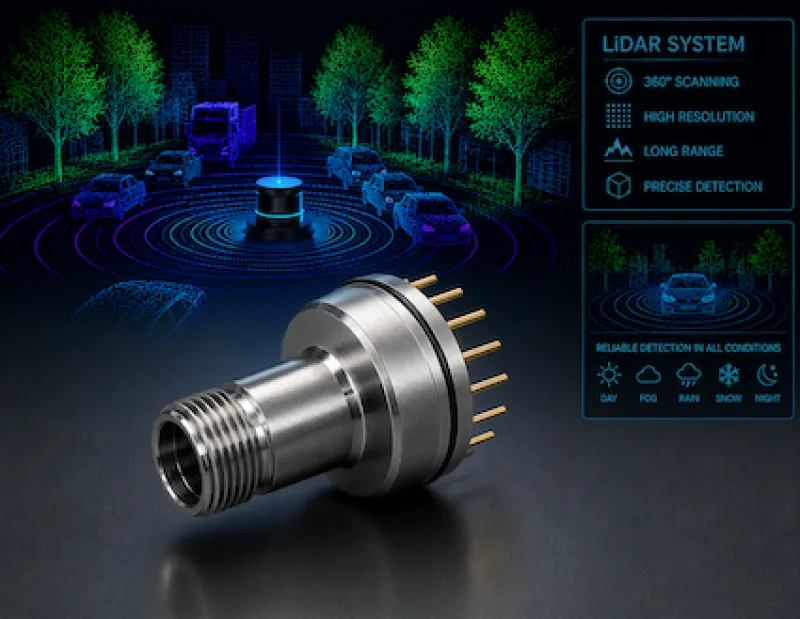
Where needed, TEGs can improve sensor performance but the trade-off is system size, complexity and power consumption
A useful way to frame this decision is in terms of required SNR headroom: if the link or measurement budget is marginal, perhaps because the design is pushing maximum range, eye‑safety‑limited transmit power, timing resolution, or ultra‑small power‑change detection, then modest TEC‑based cooling is often an effective lever.
Conversely, when signal levels are high, allowable integration times are long, or other noise sources such as laser relative‑intensity noise or amplifier noise dominate, room‑temperature operation may be entirely adequate. The objective for the system engineer is to incorporate temperature and cooling strategy into the overall sensor‑architecture trade space, alongside bandwidth, gain, and optical power, and to evaluate whether a temperature reduction of a few tens of degrees is the most efficient way to close the SNR gap in a given 1550 nm IR sensor design.
Noiseless InGaAs® APDs are Sb‑enhanced devices with very low dark current, negligible excess noise, and a low temperature coefficient of breakdown/operating voltage, that can deliver high gain and sensitivity over a wide temperature range without aggressive cooling. Their improved temperature stability means SNR and gain change much less with ambient conditions, which can substantially mitigate or even remove the need for TECs in many 1550 nm LiDAR and sensing designs.