Thermal vs. photoelectric detectors: what's the difference?
31st March 2026
Infrared (IR) thermal and IR photoelectric detectors both sense IR radiation, but they convert that radiation into electrical signals in very different ways, which affects bandwidth, noise, and how you integrate them into an IR system.
What Is an IR Thermal Detector?
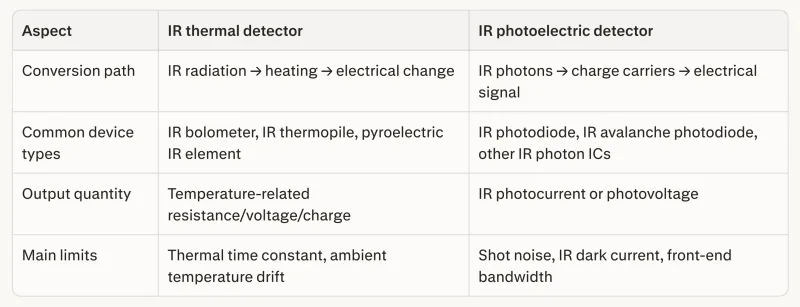
An IR thermal detector converts incident IR radiation into heat and then into an electrical signal via a temperature‑dependent property such as resistance, voltage, or polarisation. The sensing element, such as a bolometer, thermopile, or pyroelectric structure, absorbs IR energy and warms slightly, and the readout circuit measures the resulting change in that element’s electrical characteristics. Because the useful signal depends on the thermal time constant of the IR structure, response is comparatively slow but often stable and broadly responsive across the IR band.
What Is an IR Photoelectric Detector?
An IR photoelectric (photon) detector directly converts IR photons into charge carriers in a semiconductor optimised for a specific IR band. Devices such as IR photodiodes and IR avalanche photodiodes generate photocurrent proportional to the incoming IR flux, which a transimpedance amplifier converts into a voltage with bandwidths that can reach into the megahertz range and beyond. Since the conversion happens at the carrier level rather than via heating, IR photoelectric detectors can achieve high sensitivity and fast response, but they typically demand tighter bias control, careful PCB layout, and often cooling to manage dark current and noise in IR wavelengths.
IR Thermal vs IR Photoelectric Detector Physics
The two IR detector classes differ fundamentally in how they translate IR radiation into and electrical signal.
IR thermal detectors effectively integrate IR power over time, which smooths short‑term IR fluctuations but constrains bandwidth. IR photon detectors respond on carrier‑lifetime time scales, enabling much higher data rates and finer timing resolution, but exposing more of the underlying shot noise and dark‑current mechanisms.
IR Detector Speed, Sensitivity, and Spectral Response
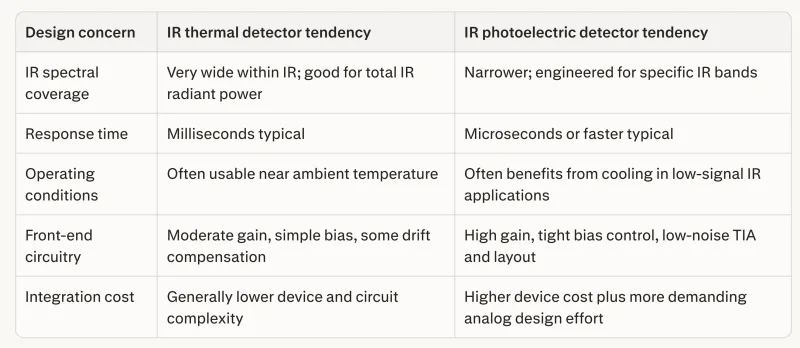
For IR sensing, speed is often the clearest practical distinction. IR thermal devices typically operate in the millisecond regime because they must heat and cool, so they suit applications such as scene‑based IR imaging or slow‑changing IR presence detection where microsecond timing is unnecessary. IR photoelectric devices can reach microsecond or faster response, making them suitable for IR time‑of‑flight, IR LiDAR, and fast IR modulation schemes where timing jitter directly impacts range or bit‑error performance.
Spectral behaviour within the IR band also differs. IR thermal detectors tend to be broadband across large portions of the IR spectrum, making them useful when you care about total IR radiant power rather than a tight wavelength band. IR photon detectors are tied to the bandgap and structure of the semiconductor, so they offer high responsivity over a defined IR wavelength range (for example, short‑wave IR or eye‑safe 1550 nm) but little response outside it.
IR Thermal vs IR Photoelectric Trade‑Offs in Design
From an IR system perspective, the important trade‑offs include operating temperature, front‑end complexity, and integration cost.
If your IR signal is slow‑changing, broadband within the IR spectrum, and comfortably above the noise floor, an IR thermal detector is often easier to integrate and more tolerant of ambient temperature variations. When you need to resolve weak, narrow‑band IR signals at high speed, such as in IR time‑of‑flight ranging or precision IR communication, an IR photoelectric detector is usually the better choice, provided you design the detector, bias network, transimpedance amplifier, layout, and thermal management as a tightly coupled IR front end rather than as loosely connected blocks.