Ambient temperature effects on IR sensing performance
9th March 2026
Ambient temperature has a direct impact on how reliably infrared (IR) sensors can detect weak signals. As temperature rises, several internal device parameters drift, changing both sensitivity and noise performance.
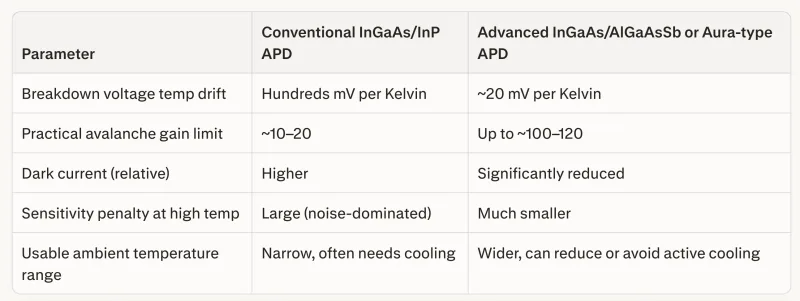
Higher temperatures increase the thermal generation of charge carriers, which raises the dark current that creates the baseline noise floor of the detector. This extra noise can swamp low-level signals, reduce signal-to-noise ratio and shorten IR system range, especially in time-of-flight and LiDAR systems. In conventional InGaAs APDs with InP multiplication layers, this limits how much avalanche gain you can use before noise dominates, typically capping practical gain in the 10–20 range.
Temperature also affects breakdown voltage. For many standard APDs, breakdown can shift by hundreds of millivolts per Kelvin, so a modest ambient change can move the device far from its intended operating point. If the bias is not actively adjusted, gain and sensitivity drift with temperature, leading to unstable performance and, in digital links, worsening bit error rates.
Best-in-class IR sensors tackle these issues at both the materials and system level. Using antimony-containing alloys such as AlGaAsSb in the multiplication layer makes impact ionisation strongly electron-dominated and more spatially confined. That reduces excess noise, allowing operation at much higher avalanche gains without the usual noise penalty. Phlux’s Aura family of Noiseless InGaAs® APDs is based on this technology. At the same time, careful device engineering can cut dark current significantly and flatten the temperature dependence of breakdown voltage to tens of millivolts per Kelvin instead of hundreds, which greatly improves gain stability over ambient swings.
For system designers, this opens new trade-offs. Extra sensitivity can be spent on:
Extending range at a given laser power.
Maintaining performance at higher ambient temperatures without aggressive cooling.
Relaxing laser and optics requirements to reduce cost and size.
Example performance comparison
To mitigate ambient temperature effects in practice:
Use bias control that tracks temperature, so the device stays at its optimal gain point.
Choose APDs with low dark current and low, well-characterised breakdown-voltage drift.
Pair the detector with a low-noise, well-matched TIA to avoid wasting the detector’s thermal headroom.
Reserve active cooling (TEC) for the most demanding use cases; newer low-noise IR APDs can often run acceptably over a wide ambient range without it.
With the right device technology and bias strategy, IR sensing performance can remain stable and high even as ambient temperature varies substantially.
More technical details on AlGaAsSb sensors, including the Aura family of Noiseless InGaAs® APDs for 1550 nm applications can be found here.