Wavelengths in IR sensing: SWIR, MWIR, LWIR and why 1550 nm matters
20th April 2026
Infrared (IR) light lies just beyond the red end of the visible spectrum, starting at about 700 nanometres (nm) and extending out to roughly 1 millimetre (mm). In practice, most sensing applications focus on a smaller portion of this range, typically from about 0.7 to 15 micrometres (µm). (One micrometre equals 1000 nanometres.)
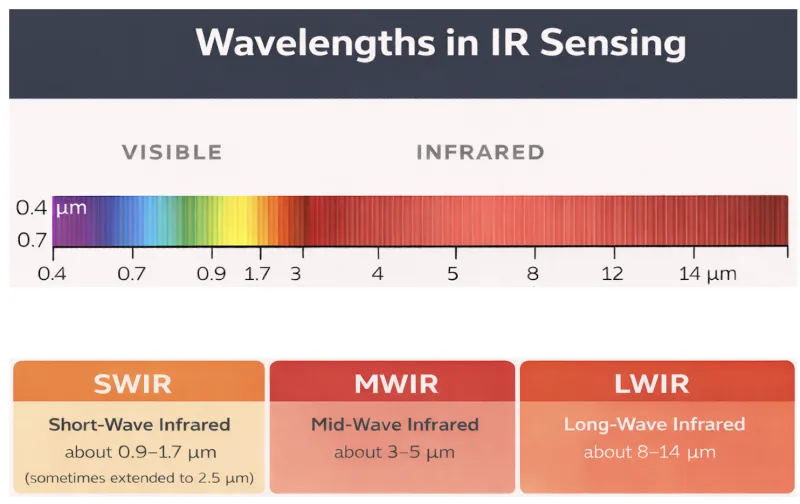
Within this region, engineers commonly divide infrared into bands such as short-wave infrared (SWIR), mid-wave infrared (MWIR), and long-wave infrared (LWIR). Typical ranges are:
SWIR: about 0.9–1.7 µm (sometimes extended to around 2.5 µm)
MWIR: about 3–5 µm
LWIR: about 8–14 µm
These divisions are not based on strict physical boundaries, but instead reflect atmospheric transmission windows and the characteristics of available detector technologies. The “gap” from 5–8 µm is mostly left unnamed because it is a poor transmission region in Earth’s atmosphere, so there are few practical imaging/sensing applications compared with 3–5 µm and 8–14 µm.
SWIR behaves more like visible light because it is mainly reflected from surfaces, whereas MWIR and LWIR are thermal infrared bands where objects emit radiation primarily according to their temperature.
SWIR applications
Because SWIR is reflective and works with familiar optics, it is widely used where image-like detail and extra contrast are needed beyond what a visible camera can provide. Typical examples include semiconductor and PCB inspection, where silicon becomes partially transparent and sub-surface features or interconnects can be inspected. SWIR is also used in food and agriculture to highlight moisture content and composition differences, and in low-light surveillance or machine vision, where it can cut through haze and certain obscurants.
Many SWIR cameras use Indium Gallium Arsenide (InGaAs) avalanche photodiode (APD) sensors sensitive from around 1 µm out to 1.7 µm, placing 1550 nm inside the SWIR region.
MWIR and LWIR applications
MWIR and LWIR dominate where temperature differences carry most of the information. MWIR (3–5 µm) is widely used for high-temperature industrial monitoring, such as furnaces, kilns and metalworking lines, and in defence and aerospace for detecting hot exhaust plumes and fast, high-temperature events at long range. LWIR (8–14 µm) aligns closely with the thermal emission of objects at or near room temperature, so it underpins many thermal imagers for building inspection, electrical maintenance, firefighting, security and medical thermography.
These bands often rely on microbolometers or cooled photon detectors rather than InGaAs devices.
905 nm and 1550 nm in context
Alongside these broad bands, two specific wavelengths are especially important for active IR sensing: 905 nm and 1550 nm. 905 nm sits in the near-infrared, only just beyond visible light, and is widely used in cost-sensitive LiDAR and range-finding equipment because it works with inexpensive silicon detectors and mature laser diode technology.
1550 nm (1.55 µm) lies at the long-wavelength end of SWIR and is the preferred choice for many long-range, high-performance systems. If someone comes into contact with light at this wavelength, the eye’s cornea and lens absorb it strongly, protecting the retina from damage. This allows significantly higher laser powers to remain within Class 1 eye-safe limits. That enables longer detection ranges, better resilience to bright sunlight, and more robust performance in fog, haze and dust. Phlux’s article, The Role of Infrared Sensors in Light Detection and Ranging (LiDAR), explains more.
Where Phlux’s 1550 nm sensors fit
Phlux focuses on 1550 nm Noiseless InGaAs® APDs for applications such as LiDAR, laser range-finding and optical fibre test equipment. With 12X the sensitivity of conventional InGaAs APDs at this wavelength, these devices allow system designers to trade that performance either for more range at a given laser power or for lower laser power at a given range.
These links provide more detailed information:
Applications for LiDAR, laser range-finding and optical sensing examples